What language should you learn? The one you will actually use. Spanish gives the fastest sense of progress and opens twenty countries; German is the most valuable on a European CV; French remains the second most-taught language in the world; Japanese or Greek will cost you more time and pay you back in a different currency. But a language you don’t enjoy is abandoned within three months, whatever its ranking says.
So before any ranking, here is what we would ask you before suggesting a teacher.
The three questions that actually decide it
- Where will you use it in the next twelve months? A job, a client, a move, a family. A language with no occasion to be spoken doesn’t survive contact with a busy life.
- What pulls you in? The films, the food, the people, the history. This is the fuel for the months when progress flattens — and it always flattens.
- How far is it from your own language? For an English speaker, Spanish and Italian are close cousins; German is a stricter relative; Japanese and Arabic are a different family entirely. At equal motivation, distance decides the timeline.
And pick one language, just one. Take it to the level where it becomes usable — roughly B1/B2 on the Common European Framework of Reference for Languages. Two languages studied in small parallel doses is the surest way to speak neither.
Spanish: the best return on effort
For an English speaker, Spanish is the language that gives the earliest feeling of actually speaking: regular pronunciation, familiar vocabulary, forgiving listeners. It’s spoken by around 500 million people across Spain and Latin America, and it’s the most useful second language in large parts of the United States.
It’s also the best first choice for an adult’s first immersion stay: progress arrives soon enough to keep motivation alive. If that sounds like you, start with our Spanish immersion programmes with a private teacher.
French: still the language of the second passport
French is an official language in twenty-nine countries and one of the working languages of most international institutions. For English speakers it’s deceptively easy to read and genuinely hard to hear: the vocabulary overlap is enormous, the spoken rhythm is unfamiliar. Hearing it at the table, every day, is what closes that gap.
Choose it for work in diplomacy, culture, luxury or humanitarian sectors — or simply because you intend to spend time in France. Whichever it is, our French immersion programmes at your teacher’s home are where we would start.
German: the most career-valuable in Europe
German is the most widely spoken native language in the European Union and the language of its largest economy. In engineering, manufacturing, logistics and research, decent German often counts for more than excellent English — simply because far fewer candidates have it.
Its reputation for difficulty is overstated: the grammar is demanding but consistent, and once the case system clicks the rest follows. What slows people down is simply not hearing enough of it — which is where a concentrated stay beats two years of weekly classes. That is what our German immersion programmes with a native teacher are for.

Italian, Japanese, Greek, Portuguese: the ones you choose with your heart
These are rarely career decisions, and that’s not a weakness: they’re the languages people keep coming back to, because the pleasure doesn’t run out.
- Italian — close to Spanish in difficulty, and the language that turns a trip into an experience. If it’s the one calling you, have a look at learning Italian with a homestay in Rome.
- Japanese — the heaviest investment on this list and the most transformative if the culture has pulled at you for years. Here is what learning Japanese with a homestay in Japan looks like in practice.
- Greek — a new alphabet to absorb first, then a language that rewards anyone drawn to history and the Mediterranean. The details are here: learning Greek in Greece with homestay lessons.
- Portuguese — consistently underrated, and the key to Brazil and a wide lusophone world. Our page on Portuguese full immersion in Portugal tells you the rest.
How long does it take to learn a language?
To reach a solid conversational level (B1/B2) from scratch, as an adult English speaker, the widely accepted orders of magnitude are:
- Spanish, Italian, Portuguese, French — the fastest group: shared vocabulary and familiar structures.
- German, Dutch — roughly twice as long as Spanish, with a grammar plateau early on and a clear acceleration afterwards.
- Greek, Russian, Polish — add the weeks needed to become comfortable with a new alphabet or a heavier case system.
- Japanese, Chinese, Arabic, Korean — three to four times the time of a Romance language. Worth it only when the motivation is deep.
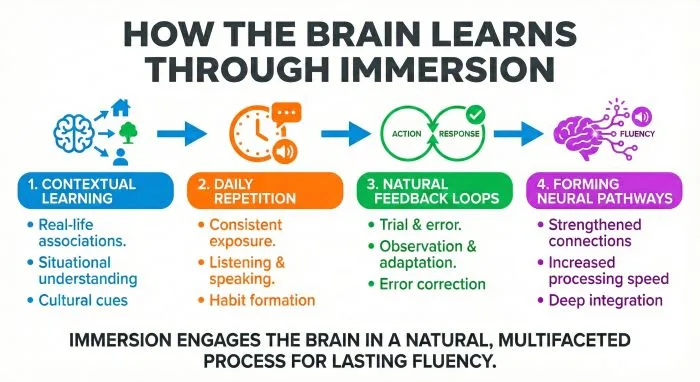
These figures assume steady practice. They collapse as soon as exposure becomes daily and active — which is the whole point of immersion: one week living in the language produces what an evening class spreads over a term.
Once you’ve chosen: what makes the difference
The decisive factor isn’t the method or the app. It’s the number of hours you spend producing the language out loud, with someone who corrects you. Everything else — grammar drills, vocabulary lists, passive listening — prepares that moment without replacing it.
That’s why staying at your teacher’s home produces results out of proportion to its length: you are the only student, the lessons are one-to-one, and the language carries on at the dinner table and on every outing. We have written up how a stay works in practice in our complete guide to language immersion for adults. And if you are still torn between formats, the best language immersion programmes compares them language by language.
Frequently asked questions
What language should I learn to improve my career?
In Europe, German is the language that most often distinguishes a CV, because demand outstrips the number of candidates who speak it. Spanish is the strongest choice for anyone working with the Americas, and French remains the safest bet for international institutions, culture and luxury.
What is the easiest language to learn for an English speaker?
Spanish and Italian: regular pronunciation, large shared vocabulary, familiar sentence structure. Both reach a conversational level in noticeably less time than German, and in a fraction of the time required for Japanese or Arabic.
Can you learn a new language after 50?
Yes, and often better than at twenty: adults bring method, general knowledge and a motivation they chose themselves. What changes is the setting they need — one-to-one lessons and a self-chosen pace work far better than a classroom of young students.
Is it better to learn two languages at once?
Rarely. Until the first language is usable — around B1 — running two in parallel dilutes exposure and delays both. One language taken to a real level, then the next.
How long does it take to become fluent?
True fluency takes years of living in the language. But that’s rarely the actual goal: B2 — understanding, being understood, working and travelling without friction — is reachable in months of steady study punctuated by periods of immersion.
Made your choice?
Tell us which language, your current level and how much time you have: we’ll find the teacher who fits and send you a proposal with no obligation. Get in touch — and if you are still hesitating between two languages, say so; we are happy to talk it through.