In Belgium the language you ask for decides where you sleep: Dutch in Flanders, French in Wallonia, English on either side, and Brussels in the middle, where you hear both in the street. You sleep in the house of the person who teaches you, you eat with them, and you are the only student at that table.
You work at the table you will eat at, so you can stop, ask, and try the same sentence again without an audience. When the lesson ends you stay in the same rooms, you sit down to eat, and nobody around you switches back to your language.
Dutch on one side of the country, French on the other
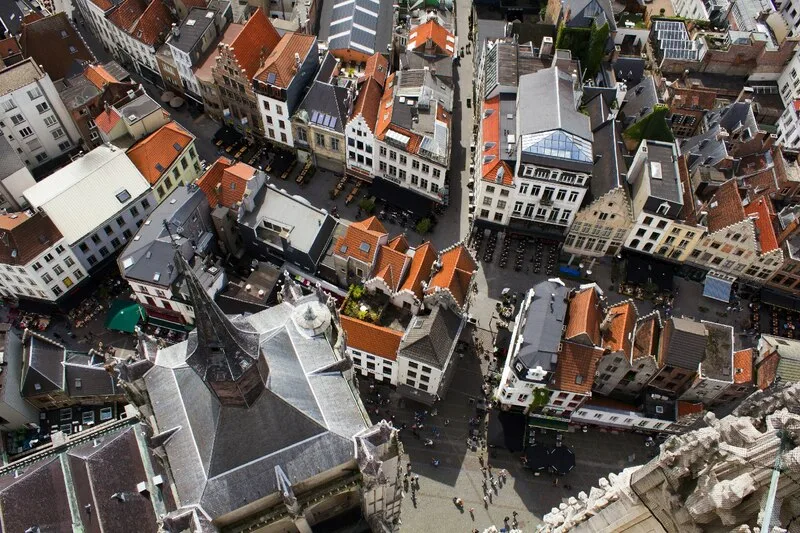
If you want to learn Dutch, I search in Flanders. The house may be in Antwerp or in a smaller town; the profile I send you names the place before you confirm. In a city you speak to strangers at the bakery; in a village you speak longer, mostly to the person who is teaching you. I have written a separate page for staying with a teacher in Antwerp.
Further south, in Wallonia, the language of the house is French, and you arrive via Brussels or via Lille — convenient if you are coming up from northern France. Brussels is not in Wallonia. It sits in the middle; I still place you in a house that speaks the language you asked me for, on one side or the other. If you want to go out in the afternoon, visits are booked before you leave: your teacher takes you, transport and tickets included, and a good deal of the talking happens on the way, not only once you arrive.
English is taught on both sides. If it is English you care about more than Belgium, the same homestay exists in the countries on the English immersion page; if it is French outside Wallonia, the French immersion page adds France, French-speaking Switzerland and Canada.
If you already live in Flanders, I have a separate page for that — and you can still take the homestay or come only for the hours; you tell me. When you need a transfer, I arrange it from Brussels or Antwerp for a Dutch-speaking house, and from Brussels or Lille for a French-speaking one.
Sleeping in the house, or coming only for the lessons
There are two formulas, and the hours are the same in both. What changes is whether you go home in the evening.
In the homestay you have your own room and you eat three meals a day with the family. With lessons only, you come for the hours at the teacher’s home, and that is all — no room, no meals. Which of the two suits you is yours to say, and living nearby does not mean I book only the lessons.
You arrive on a Sunday and leave on a Saturday, with lessons Monday to Friday, on any dates in the year. If you need to get in the day before, I add the night, meals included. You choose the hours when you book: ten, fifteen, twenty, twenty-five or thirty a week. At ten hours, the lessons go with activities or visits, because that is how you get out of the house. You are the only student; in the house, people do not speak your language.
The person who teaches you is the person who opens the door: a qualified teacher, in a house that has been inspected before I offer it to you. You receive the profile first — who they are, where they live, whether there are animals or children. If it does not sit right with you, I look for another family. A private bathroom exists as an option, depending on the house.
The Je Suis Polyglotte Method: Your Language Immersion
Excellence standards to guarantee your success
Discover all the details of our method and available options
Who I look for a house for
Twenty-five or thirty hours leave little in the week except the language you came for: a file, a meeting, the words of a job. Fifteen or twenty leave the afternoon free, which helps when you are not in a hurry. Because the lessons are private, they start where you are, including from nothing. If there is an exam, the hours go on the format of the paper. If you are retired, say so — I look first at houses where the days are quieter, and the hours can sit in the morning so the rest of the day is yours.
If it is your child who is going, what you want to know is who they spend the day with. They are the only student, and they are looked after day to day by the host family — the same people who ask, at supper, how the day went. When they sleep at the teacher’s and they are under eighteen, I book activities or visits with the lessons, so the afternoon is out of the house and not in the bedroom with a phone. Under sixteen, the transfer is in the proposal unless you travel with them: the host family or the driver is waiting, and I send you that person’s name before they leave. Under thirteen, an adult in the house is with them at all times.
One rate for Dutch, French and English
The Belgian tariff does not change with the language. One sum covers the room, the three meals and the private lessons when you take the homestay. What moves the total is the number of hours, the number of weeks, and what you add — a visit, a transfer, a private bathroom. Travel and pocket money stay yours. My proposal adds up what you have asked for.
Here is a sample weekly price, but your final quote will depend on the teacher and home you choose.
Every stay is tailor-made: the prices below are examples. The most important step is to talk about your project so we can match you with the right teacher and home.
"Lessons Only" programmes are also available for learners who prefer individual lessons without staying at the teacher's home.
⚠ For a student under 18 staying at the teacher's home, General Activities and/or Cultural Visits go with the lessons.
What's included in your stay:
- Full-board accommodation at your teacher's home (private bedroom)
- Three meals a day shared with your teacher and, when present, their family
- Daily one-to-one lessons with a native teacher
- Cultural and everyday activities based on your chosen programme (cooking workshops, excursions, guided tours, local markets, outdoor outings, etc.)
- Total immersion in your teacher's daily life, from breakfast to evening
These are indicative starting prices and may vary. The final cost depends on the destination, length of stay, time of year, accommodation and chosen programme.
We can send you the teacher profile suitable both for a full-immersion stay and for a Lessons Only programme. After your enquiry, you can compare different options and adjust the programme to your needs.
What I am asked before anyone picks a side
Are Flemish and Dutch two different languages?
No. Flemish is Dutch as people speak it on this side of the border. Grammar and spelling stay the same; the accent, the pace and a handful of everyday words do not. If you will use the language here, that is the accent you want to hear at breakfast. You do not have to go to the Netherlands to learn it.
I already live here: can I take lessons without sleeping at the teacher’s house?
Yes. Living here does not lock you into one formula. Some people keep their own bed and come for the hours, in a short block or spread over several weeks; others still take the homestay because they want days where their own language never comes back into the conversation. I book either the same way, on either side of the country.
If my child travels alone, who is waiting when they arrive?
The host family or the driver who has the transfer is waiting — in Brussels, Antwerp or Lille, depending on the house. You get that person’s name before they leave.
Send me the language and the dates
I can start looking as soon as I know which language you need — Dutch, French or English — when you are free, and what you would like to be able to do by the end. If you cannot name a level, ‘I understand but I don’t dare answer’ is enough, and if it is your child, their age and what worries you matter as much as the dates. I look at who is free on each side for those dates and send you a profile with a proposal, which you read before anything is confirmed. The general questions are in the F.A.Q., and the contact page is there when you are ready to go ahead.