
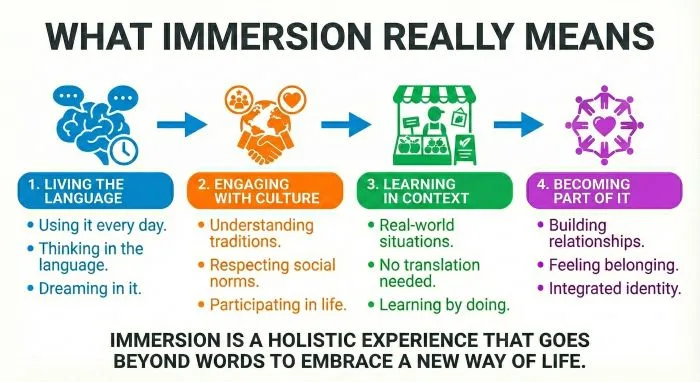
What immersion in a language really means begins with this: a language must be learned by being a part of your everyday life.
Immersion is not something that is developed in a classroom, but something that occurs as a result of human experience.
By staying with a native-speaking language instructor, every aspect of your day presents the chance for immersion in the language, as well as the acquisition of its meanings through immersion within its culture.
What is language immersion?
You stay with your teacher, and learn the language by living it: through personalised language lessons and/or activities, communication with your host, mealtimes with the family, outings, interaction with new friends and cultural visits.
The Deeper Impact of Immersion
Immersing oneself in a language is a profoundly educational experience, one that extends far beyond what a traditional language school can offer, since living the language with total immersion, practicing the target language in everyday life, during meals and while doing activities, is the best method to reach communication skills in short time
This is indeed the idea that one learns a language by living it, whereby any and every activity is performed within the language.
Rather than studying vocabulary words in a classroom setting, you are exposed to vocabulary knowledge through meal conversations with your host family, exploring a marketplace, or investigating cultural points of interest with your teacher.
This is more about immersing oneself in a culture and witnessing life from a different perspective than it is about language proficiency. Immersive experiences elevate the art of learning a new language from a passive educational one to an active one that can enrich one’s life.
Immersing oneself in a foreign environment is the best option for a selective learner because it provides a distinctive opportunity to grow personally and connect meaningfully with other human beings.
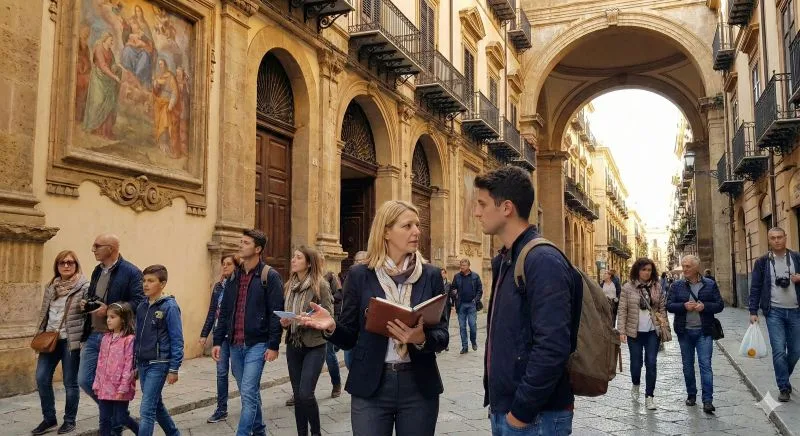
What are the different types of language immersion programs?
Immersion programs can take a wide range of forms such as: school-based immersion programs, online-only immersion programs or homestay immersions; not all of these are to be considered full immersion language programs, because exposure to language is limited.
Yet, to experience true immersion, there is no better option than homestay immersion programs where one can live and study at one’s private teacher’s place.
Compared to what is available at a regular school, where you attend classes with other children, and what is called partial immersion, which is limited to specific subjects,
a homestay program provides complete immersion 24/7. This is because you are the only student being accommodated, which ensures that your experience meets your needs.
These one-on-one settings present endless opportunities to immerse yourself in native conversation, receive feedback,and experience life and customs within your host nation to a degree that is not possible with other types of program offerings.
For those looking to immerse themselves in the language and experience its culture, there is no other offering like the homestay immersion experience.
What does a typical day look like in a language immersion program?
A typical day during homestay immersion is a seamless integration of formal learning and immersion into the local culture.
Your day will begin not with a ringing bell but with a shared breakfast meal with your host teacher and their family, during which conversations take place freely in the target language.
This is followed by one-on-one lessons designed to meet your goals, which focus on building your vocabulary and grammar to equip you to handle everyday situations. Usually, lunch with the host.
After lunch, the second half of your lessons can involve applying what you have learned to everyday life, which can range from visiting a local museum to cooking a regional meal to running errands with your host.
These are more than just travel activities. They offer true experiences that put what you’ve learned into context.
The evening concludes with dinner and discussions, which help consolidate what you’ve learned.
Every single minute, from dawn to dusk, is a rich chance to gain knowledge and experience cultures.
Is it the same program everyday? Of course, while the base programme is defined in this way it can be adjusted to your needs according to the teacher’s availability
Explore with us the reasons for immersion’s strength, as well as its workings in practice.
Continue further to discover how immersion will be defined merely as its essence or purpose: being immersed in the language, being exposed to it through experience, comprehending it in terms of a larger culture.
What are the core principles behind the language immersion teaching method?
The Language Immersion method is grounded in a couple of very simple yet powerful ideas. The most fundamental idea is that language is a tool, not a school subject.
This means that there is no emphasis on school subjects, but rather on using the language applied naturally during immersion.
Learning happens naturally rather than through translations and standard lessons.
Another key principle is comprehensible input, which involves being constantly exposed to language you can understand, thereby helping you acquire new grammar naturally rather than trying to memorize rules.
This is paired with constant output, providing you with opportunities to speak and interact from the very beginning.
Finally, and most crucial to having a true transformative experience, is that of cultural integration. Immersive teaching understands that languages and cultures are intertwined entities. You not only need to know what to say, but you also need to know how and why you say those things within that particular culture.
This ensures that you are not only building linguistic fluency but also developing a level of cultural understanding and knowledge that helps make communications more authentic and effective.
Once learners comprehend the real meaning of immersion, they will realize that a language is more than a set of rules,
as they will realize that language immersion is more than a language system. Immersing oneself in a language will provide linguistic improvement, as well as other aspects such as human interaction, cultural knowledge, and self-growth.