
To comprehend the dynamics of language immersion for adults, you must begin with the mechanics that occur in real-world education. Living with a native-speaking teacher,
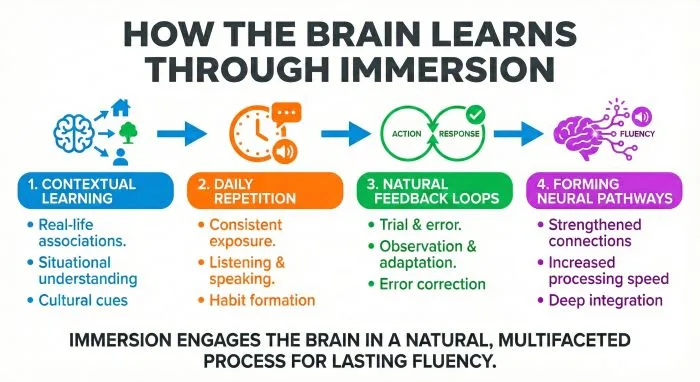
the language is immersed in every gesture, every conversation, every aspect of daily interaction. You don’t examine the rules, as with traditional education, but pick them up through immersion.
And immersion is the most natural form of human cognitive education, that is, education through meaning, not through rote memory.
How does language immersion work for adults?
For adult learners, language immersion programmes immerse them in an everyday life engagement using the language in a real context. Living with a host provides them with a safe and friendly environment. Immersive approaches involve surrounding yourself with and engaging your mind with the target language while being immersed in the culture.
This is much more involved than what is typically done within a classroom setting.
Immersive initiatives like daily interactions, cultural visits with the host; involve being part of a culture by engaging with its everyday aspects, such as mealtime with your host family.
In addition, researches, such as one conducted at Georgetown University, indicates immersion can result in native-like processing of grammar rules within the brain. Your brain is beginning to function like that of native speakers, which is a big deal, no matter which language you are trying to learn. Immersion, on the other hand, provides something much more valuable than what can be gained within a classroom: discovery and enrichment.
Immersed, you are not merely building a vocabulary and grammatical knowledge base; you are unlocking how people’s minds work, what they value, and how they communicate.
This type of knowledge is what makes memories and what will turn studying a foreign language into more than an academic pursuit; it will make it an enriching experience.
How can I create a language immersion environment at home?
You can create a limited form of language immersion by adapting daily habits to increase your involvement in the target language. Although actual immersion requires living with a native speaker in their country, you can enhance this rich experience by continuing to expose yourself to your target language at home. However, it is a fact that one can’t experience this rich culture and human interaction within an immersion experience at home. When one is at home, they can adjust the settings on their device, watch videos, and tune into podcasts. Still, they can’t experience conversations during meals, learning about traditions, and engaging in human interactions, which are essential aspects of studying foreign languages.
A professional immersion program offers what home study, no matter how intensive, cannot: the chance to experience the language within its cultural context, to comprehend meanings not only within words but also within values and perspectives, and to build memories that last a lifetime. Home activities are great for keeping one sharp between programs, but they can’t compare to the rich experience one can get by immersing oneself in a culture.

How effective is language immersion compared to traditional language learning methods?
Immersing oneself in the language is highly effective when compared to other educational programs, particularly for those seeking more than just knowledge. They are seeking a real experience.
Traditional approaches to learning a foreign language involve explicit grammar lessons and memorization within a classroom setting, whereas immersion relies on experiences that occur in everyday life. Immersive experiences cannot only help you gain linguistic proficiency but also provide insight into the culture.
Studies at Georgetown University indicate that immersion is more successful in terms of native-like grammar processing by learners’ brains. However, there is more to immersion than mere scientific facts. Immersion provides something increasingly hard to find in this digital age: the chance to unplug, immerse oneself in a different culture, and grow.
You are not only committing to memorizing grammar points related to verb conjugation. You are engaging in conversations over supper, uncovering rituals and habits, and forging bonds which break down barriers simply because you speak a different language.
Examine with us, in greater depth the many reasons why language immersion is such a powerful tool, as well as aspects that set immersion apart from other forms of learning.
Continue to understand immersion as a process, immersion as adults, immersion as compared with other immersion models, and the progression that takes place.
Contact us to get the best suggestions tailored to your needs
How long does it take to become fluent through language immersion?
You are the only student and you are totally immersed in your target language, in this way, noticeable progress happens quickly for most learners.
Immersive experiences yield better results than conventional learning processes, with improvements being noticeable within weeks. Immersive experiences can lead to significant improvements in linguistic skills within 1 to 4 weeks. This is a time when you can gain proficiency in conversing, significantly enhance your comprehension capacity, and increase enough confidence to speak out.
The fluency level you will reach, depends on your starting level and goals.
A considerable number of learners have indicated that they can manage to converse, relate to community life, and establish strong relationships within two weeks while being fully immersed.T he change, however, does not stop at the level of language. You will return home with a deeper appreciation and understanding of another culture, new perspectives on life, and experiences that will enrich your life.
The difference lies within the level and nature of experience. Being paired with a host teacher who is a native speaker and being exposed to everyday life alongside a host family is equivalent to immersing yourself in a destination, resulting in accelerated knowledge gain and offering a level of personal development unique to travel.
Discover what is language immersion
With this demonstration of immersion, adults will better comprehend the entire process, leading them through the path of learning. However, immersion includes not only classes, but day-to-day habits as well.
Immersing individuals in languages verifies that language acquisition isn’t merely within the classroom, but through discovery, interaction, and the quiet pulse of day-to-day experiences.